Which book do you irrationally cringe away from reading, despite seeing only positive reviews?
Hm. I've had a lot of friends and family try to sell me on reading Redeeming Love, by Francine Rivers. But I'm so down on inspirational fiction as a genre, as a reaction to the few years where I read it exclusively, because I thought I was protecting my mind from sinful influences or something, that I haven't been able to bring myself to attempt it yet.
If you could bring three characters to life for a social event (afternoon tea, a night of clubbing, perhaps a world cruise), who would they be and what would the event be?
Lord Peter Wimsey, Richard Sharpe, and Joscelin from the Kushiel series. For dinner. But they probably wouldn't get along at all, what with Lord Peter being so suave and sophisticated and Sharpe so NOT and Joscelin would be stuck as the peacemaker which isn't really his strength, so maybe I'd have them each over separately. For dinner. Just dinner. Nothing beyond that. And that's my story and I'm sticking to it...
(Y'all don't believe me, do you?)
(Borrowing shamelessly from the "Thursday Next" series by Jasper Fforde): You are told you can't die until you read the most boring novel on the planet. While this immortality is great for awhile, eventually you realize it's past time to die. Which book would you expect to get you a nice grave?
The Red Badge of Courage. Only I've already had to read it TWICE, in 7th grade and 11th grade, so I should already be in my early grave...
Come on, we've all been there. Which book have you pretended, or at least hinted, that you've read, when in fact you've been nowhere near it?
I don't think I've done that. Really.
You're interviewing for the post of Official Book Advisor to some VIP (who's not a big reader). What's the first book you'd recommend and why? (If you feel like you'd have to know the person, go ahead and personalize the VIP).
If this VIP isn't much of a reader, I probably shouldn't start them on Shakespeare or even Austen because the language itself would be too daunting for them. OK, I'm going to assume this is a political VIP, and one who's reasonably intelligent despite not being a big reader. I'll give him John Keegan's The Mask of Command because it's all about the use and abuse of military power, and the mini-biographies of the four leaders (Alexander the Great, Wellington, Grant, and Hitler) give it a strong narrative thread.
A good fairy comes and grants you one wish: you will have perfect reading comprehension in the foreign language of your choice. Which language do you go with?
French. I need it for my research, and I think it would help me write better English dialogue for my French characters, but I don't know when I'm going to find the time to teach myself.
A mischievous fairy comes and says that you must choose one book that you will reread once a year for the rest of your life (you can read other books as well). Which book would you pick?
Pride and Prejudice. I already read it almost every year anyway.
I know that the book blogging community, and its various challenges, have pushed my reading borders. What's one bookish thing you 'discovered' from book blogging (maybe a new genre, or author, or new appreciation for cover art-anything)?
How good the current generation of YA is.
That good fairy is back for one final visit. Now, she's granting you your dream library! Describe it. Is everything leather bound? Is it full of first edition hard covers? Pristine trade paperbacks? Perhaps a few favorite authors have inscribed their works? Go ahead-let your imagination run free.
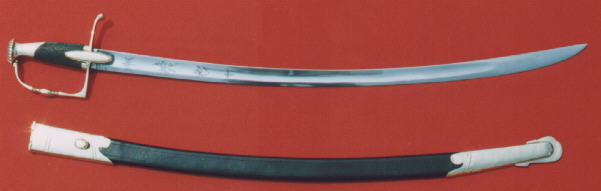
It's a big, lofty room on the top floor of my dream home, wall-to-wall books, nothing special in terms of leather-bound or first editions, just books I love, with favorite authors given prominent placement. I have a comfortable couch to lounge on and a great big desk where I sit at a window looking out over mountains, ocean, or both. Above my desk hangs this sword. It's a plain blade, but it's the one the Big Damn Hero of my WIP is given by his general at the end of the book, that he carries throughout the series, and in this particular fantasy the good fairy has also made it so my WIP sells and the series makes my name as an author.
Wednesday, February 6, 2008

Sunday, February 3, 2008
At the risk of sounding like one of those feminists with no sense of humor...
...the author of the dual biography of Napoleon and Wellington I'm currently reading really needs to stop referring to Josephine Bonaparte, Kitty Pakenham Wellesley, Emma Hamilton, really any woman who happened to share a bed within or without wedlock with any of the military heroes of the day, as "petticoats." Once or twice would be mildly amusing, but every. single. time. he needs to reference someone with two X chromosomes, it gets annoying.
Saturday, February 2, 2008
The Ever-After Bird (Book #10)
The Ever-After Bird (Ann Rinaldi, 2007) is an older kids'/YA book about a Pennsylvania girl in 1851 who, when her neglectful abolitionist father dies, is taken in by her uncle, an abolitionist ornithologist who travels the South sketching birds and telling slaves about the Underground Railroad. Cecilia, the heroine, has her doubts about the cause at first, since she resented her father's neglect, and he was murdered while trying to protect runaway slaves. She comes around after seeing the horrors of slavery firsthand--and this is a Message book, designed to educate kids about the evils in our history. But it's well-executed and readable.
Thursday, January 31, 2008
Taste (Book #9)
Taste: The Story of Britain Through Its Cooking (Kate Colquhoun, 2007) makes social history out of a topic--British cuisine--that's often treated as a joke. It's full of fascinating tidbits about everything from the configuration of medieval banquets to WWII rationing, but you have to wade through a dry, encyclopedic presentation to find them.
Sunday, January 27, 2008
2007 in books
Here it is almost the end of January, and I still haven't posted any kind of summary of my 2007 reading. I was going to just skip it, since it feels way too late for a "Best of 2007" post. But it was an unusually good reading year for me, and I wanted to acknowledge some of my most memorable reads. These are the books that stuck with me. I read plenty of other books that made me smile, that whiled the time away pleasantly, or that gave me useful information, but the books on this list had a deeper impact: they expanded the world of my imagination and/or made me see the world from a new angle.
This isn't a ranked list; I'm simply working my way backward through my blog posts from the year.
It's Not About the Accent, by Caridad Ferrer. A YA coming of age story that made me reflect on how I define myself even thought I'm a good 15 or 20 years past the "coming of age" stage.
Fray, by Joss Whedon. So, it's a graphic novel. It's also a powerful, tight piece of storytelling, and I only hope my own action-adventure WIP will even approach its impact.
The Mask of Command, by John Keegan, and Sharpe's Waterloo, by Bernard Cornwell. Reading these books back-to-back gave my imagination a vivid "Waterloo room."
Here if You Need Me, by Kate Braestrup. Lately I'm drawn to stories of non-fundamentalist faith journeys, as I'm still trying to work out what life means in a world with no absolutes.
Empire of Ivory, by Naomi Novik. The second strongest outing in the series thus far, and the cliffhanger from hell!
American Band, by Kristen Laine. What it's like to grow up in America today, viewed through one season of a competitive marching band.
Survival of the Sickest, by Sharon Moalem. Popular science in journalistic style, so nothing Deep or Moving, but the examples have stayed in my mind.
Will the Vampire People Please Leave the Lobby, by Allyson Beatrice. Online communities and how they flow into real life.
Swords Around a Throne, by John Elting. An encyclopedic reference to Napoleon's Grande Armee. Sounds dry, but reading it opened my eyes to the French side of the wars.
The Wild Trees, by Richard Preston. Mad scientists who never got over their childhood love for climbing trees.
Born Fighting, by James Webb. The first book I've ever read focusing on the Scots-Irish--i.e. my people.
Gallows Thief, by Bernard Cornwell. I wish he'd turned this one into a series...
Rough Crossings, by Simon Schama. The American Revolution from a completely different angle.
Saturday, January 26, 2008
God's Harvard (Book #8)
Patrick Henry College, the subject of God's Harvard: A Christian College on a Mission to Save America (Hanna Rosin, 2007) is no ordinary Christian college. It's designed specifically for kids from a conservative homeschool background, and its goal isn't to educate students for the pulpit and/or the wide vocational spectrum of modern life: instead, they're training culture warriors for the front lines of the religious right. The founder's stated dream is that in 30 years, the director of the Best Picture Oscar winner will receive a call from his former Patrick Henry roommate--the president of the United States. The only majors are government, history, literature, journalism, and classic liberal arts.
Rosin, a Washington Post reporter, followed a tumultuous year in the life of the still new and experimental college (it's less than a decade old). I wanted to weep for some of the students who were so bright and so ambitious being forced through a system that's ultimately so restrictive, like the brilliant girl who was groomed to be First Lady rather than President, though I also wanted to wring the kids' narrow-minded young necks for seeing the 2006 elections as a case of "evil winning." PHC is emphatically a Republican endeavor. They'd see someone like me, a Christian who votes Democrat and is supporting Barack Obama, as at best deluded and at worst willfully rebellious and evil. And...like it or not, they're here to stay. What remains to be seen is whether they'll remain influential.
Rosin, a Washington Post reporter, followed a tumultuous year in the life of the still new and experimental college (it's less than a decade old). I wanted to weep for some of the students who were so bright and so ambitious being forced through a system that's ultimately so restrictive, like the brilliant girl who was groomed to be First Lady rather than President, though I also wanted to wring the kids' narrow-minded young necks for seeing the 2006 elections as a case of "evil winning." PHC is emphatically a Republican endeavor. They'd see someone like me, a Christian who votes Democrat and is supporting Barack Obama, as at best deluded and at worst willfully rebellious and evil. And...like it or not, they're here to stay. What remains to be seen is whether they'll remain influential.
Tuesday, January 22, 2008
Almost French (Book #7)
Almost French (Sarah Turnbull, 2001) is the memoir of an Australian woman who meets a Frenchman while traveling in Europe and ends up moving to Paris to live with him. It's a humorous tale of culture clash and learning to understand and value differences.
Reading it, I remembered my own year in England, which brought its own share of culture clashes and humorous miscommunication. But compared to Turnbull, I had it easy, very easy. England and America are cultural cousins--siblings, really. And for all the "separated by a common language" jokes, aside from some early embarrassments (I can't BELIEVE no one warned me about "fanny") and confusions (I didn't know what a "courgette" was until the cook brought out the pot of zucchini to show me), I never had any trouble communicating. And when called upon to explain or defend some aspect of American current events, I could do so fluently--this was 1997-98, so I was saddled with the Louise Woodward case and the Monica Lewinsky scandal, among other things. Poor Turnbull at first was stuck trying to explain Australia when her vocabulary didn't extend much beyond, "Not all think same. Much change."
I enjoyed the book as a window into modern France. I'm getting to know the France of 200 years ago with some intimacy, and it's illuminating to see what it's become since. Someday I hope to travel extensively there--so much art, so much food, so much history and even prehistory!--but I don't think I'd have the cross-cultural energy to live there. Turnbull's life sounds exhilarating but exhausting. (England I'd move back to in a nanosecond, given the opportunity.)
Subscribe to:
Posts (Atom)